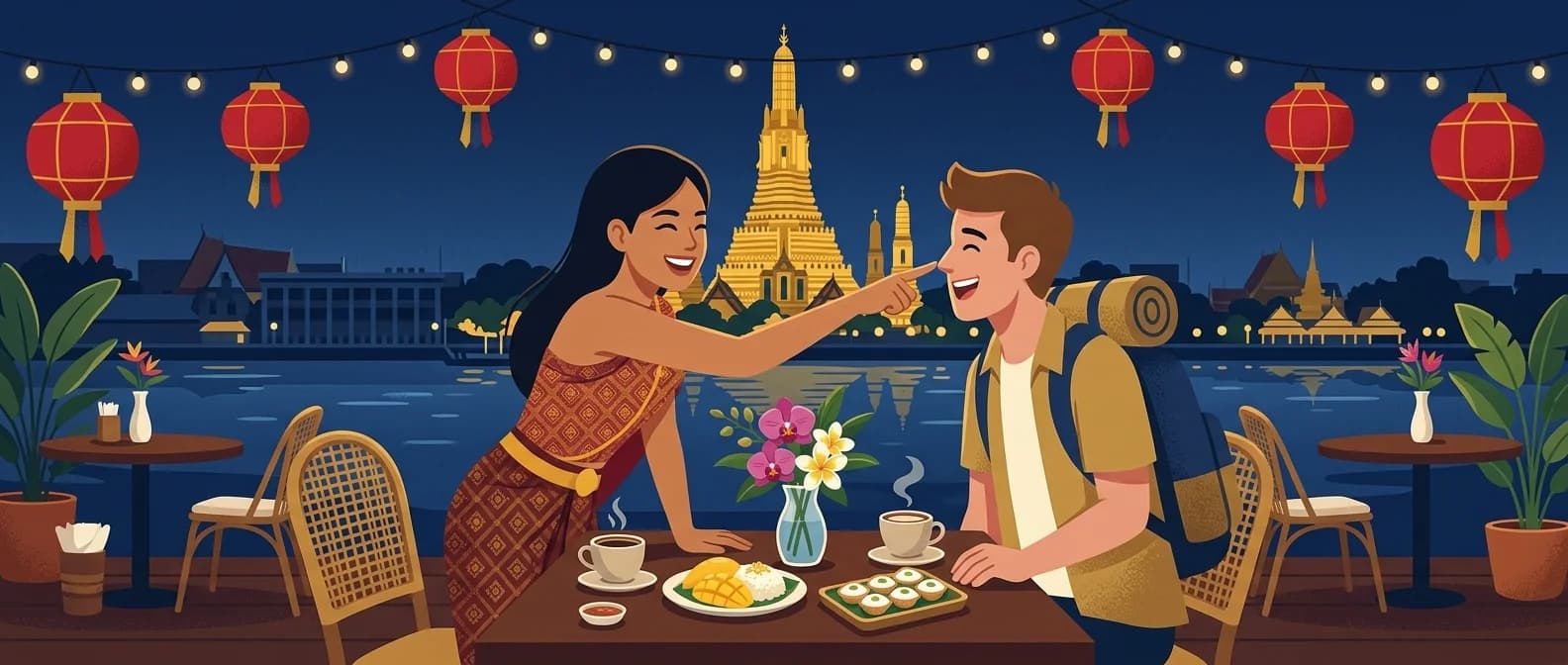
I love you in Thai is รัก (rák) — one syllable, high tone, and more versatile than the English phrase. The textbook version is ฉัน รัก คุณ (chán rák khun, women) or ผม รัก คุณ (phǒm rák khun, men), but what Thais actually say to each other most of the time is just รัก นะ (rák ná) — love you, with a soft particle to warm it up.
That gap between the textbook phrase and the real one is the story of this whole topic. The internet will give you ฉัน รัก คุณ (chán rák khun) and move on, but Thai romance runs on teasing, nicknames, and showing more than telling. After years in Thailand, one thing that stands out to me is how playful Thai relationships are. You show affection by teasing your partner and being ติงต๊อง (ting-tɔ́ɔng, silly, crazy) together, and that warmth doesn't need a formal "I love you" to carry it.
So this guide starts with the phrase and the tones, then goes where most guides don't: the words Thais actually use at each stage of a relationship, the endearments that make foreigners laugh (yes, อ้วน (ûan) — "fat" — is a term of affection), the cultural norms around PDA, and the digital love language of LINE stickers and จุ๊บๆ (cúp cúp).
Key takeaways
- I love you in Thai is รัก (rák, high tone). The full sentence ฉันรักคุณ (chán rák khun) is textbook; the casual รักนะ (rák ná) is what couples actually say.
- Thai has a clear like → love spectrum: ชอบ (chɔ̂ɔp, to like) → หลงรัก (lǒng rák, infatuated) → รัก (rák, love). Getting the level right matters.
- Thai couples rarely say "I love you" as often as Western couples. Love is shown through actions — ดูแล (duu-lææ, taking care) says more than words.
- แฟน (fææn) means boyfriend, girlfriend, or partner — it's gender-neutral, which is a genuinely progressive feature of the language.
- PDA norms are more reserved than in Western countries. Hand-holding is common; kissing in public spaces is generally avoided.
The quick answer: how to say I love you in Thai
The key syllable is รัก (rák): high tone, short vowel, sharp stop at the end. It should feel like a quick, bright punch — not drawn out. If the tone marks are new to you, our guide to the five Thai tones explains the whole system, and you can paste any phrase from this page into the transliteration tool to hear it word by word.
One thing that surprises learners: Thais drop the pronoun constantly. Between a couple, รัก นะ (rák ná) is complete and natural. The full ฉัน รัก คุณ (chán rák khun) sounds like textbook Thai — fine for a first confession, a bit stiff for daily use. Think of it like the difference between "I love you" and "love you" in English, except Thai leans even harder toward the short form.
From liking to loving: the Thai spectrum
Thai draws sharper lines between stages of affection than English does. Using the wrong level is a real miscommunication, not just a style choice:
ตกหลุมรัก (tòk-lǔm-rák) is worth savoring: "fall into a love hole." It captures the involuntary, slightly helpless feeling of falling for someone, and Thais use it casually in conversation. It's also a noun-verb distinction worth knowing: รัก (rák) is the verb ("to love") and ความรัก (khwaam-rák) is the noun ("love" as a concept).
Compliments: you're beautiful, you're handsome
These phrases do real work in Thai — compliments are given freely and received with a smile rather than deflection:
น่ารัก (nâa rák) is the Swiss army knife of Thai compliments. Literally "worthy of love," it covers cute babies, adorable cats, attractive people, and a nicely plated dessert. It's never wrong and always welcome.
Terms of endearment: what Thai couples call each other
This is where Thai gets fun. Forget the "darling" and "sweetheart" you might expect:
The nickname that gets every foreigner: อ้วน (ûan), "fat." In Thai culture, calling your partner อ้วน (ûan) is playful and affectionate, not an insult. I find it hilarious and charming — it's part of the teasing warmth that runs through Thai relationships. Similarly, ปากหวาน (pàak-wǎan, “sweet mouth”) means smooth-talker or flatterer, and it's usually a half-compliment.
But the real endearment in Thai is the nickname. Every Thai person has a ชื่อเล่น (chɨ̂ɨ-lên, a play name), often given at birth and completely unrelated to their real name — Ice, Bank, Ploy, Boom. Using someone's nickname is itself a marker of closeness.
ตัวเอง (tua-eeng) deserves a note: it literally means "self" or "oneself," and younger Thai couples adopted it as a trendy endearment — roughly equivalent to "babe." If your Thai partner calls you ตัวเอง (tua-eeng), they're being sweet, not philosophical.
Relationship words
แฟน (fææn) is worth highlighting: it's gender-neutral. Unlike English, where you have to specify boyfriend or girlfriend, แฟน (fææn) covers any partner regardless of gender. Context or additional words clarify if needed, but often they don't — a genuinely inclusive feature of the language.
The casual/formal split matters for spouse terms. เมีย (mia) and ผัว (phǔa) are what couples use at home; ภรรยา (phan-yaa) and สามี (sǎa-mii) are for formal contexts, introductions to elders, and official documents. Using ภรรยา (phan-yaa) about your wife to a friend sounds like calling her "my spouse" in English — technically correct, oddly stiff.
One more: after a couple has children, they often start calling each other พ่อ (phɔ̂ɔ, dad) and แม่ (mæ̂æ, mom) instead of their names or endearments. It's a cultural shift that marks a new family identity — and it surprises every foreigner the first time.
Miss you, feelings, and everything in between
คิดถึง (khít thɨ̌ng) does double duty as "to miss" and "to think of." When your Thai partner texts คิดถึง นะ (khít thɨ̌ng ná), it means both "I'm thinking of you" and "I miss you" — which is rather nice.
Why is it spelled chan rak khun, chun rak koon, jun luk koon...?
The romanization chaos is even worse for love phrases than for thank you, because more of them get whispered and then googled by ear. The same phrase appears across the internet as:
| You've seen | What it is | In Thai |
|---|---|---|
| chan rak khun / chun rak koon | ฉันรักคุณ (chán rák khun) | I love you (female) |
| phom rak khun / pom rak koon | ผมรักคุณ (phǒm rák khun) | I love you (male) |
| rak na / lak na | รักนะ (rák ná) | love you (casual) |
| tee rak / ti rak | ที่รัก (thîi rák) | darling |
| narak / na rak | น่ารัก (nâa rák) | cute |
| faen / fan / phaen | แฟน (fææn) | partner |
| kit teung / khit thueng | คิดถึง (khít thɨ̌ng) | miss you |
The spellings are all attempts to write Thai sounds in English letters, and everyone's ear works differently. None of them are "wrong," but none of them capture the tones — and in Thai, tones change meaning. On this site every romanization runs through the same engine, so a word is spelled identically on every page. When you find Thai text in the wild, paste it into the transliteration tool to see and hear exactly what it says.
Flirting in Thai
For the bold:
LINE is the default communication tool for every single generation in Thailand. But if you're trying to flirt with Gen Z or a younger crowd, LINE can feel a bit old-school. Switch to Instagram to keep things fun: ขอ ไอจี ได้ ไหม (khɔ̌ɔ ay-cii dâay-máy, “Can I have your IG?”).
จีบ (cìip) is the Thai verb for courtship — the pursuit stage where you're actively trying to win someone over. Getting "jìip-ed" is a compliment. It's more structured than casual Western flirting: someone จีบ (cìip) you, and if it works, you คบ กัน (khóp kan).
A love confession gone right
chûang-níi phǒm khít thɨ̌ng khun mâak
I've been thinking about you a lot lately.
cà-ring lə̌ə kɔ̂ khít thɨ̌ng mɨ̌an-kan
Really? I think about you too.
phǒm rák khun ná yàak bɔ̀ɔk maa naan lǽæw
I love you. I've wanted to say it for a long time.
chán kɔ̂ rák khun mɨ̌an-kan
I love you too.
How to respond to I love you in Thai
Nobody else covers this, which is odd — it's the first thing you need after learning the phrase:
ก็ เหมือน กัน นะ (kɔ̂ mɨ̌an-kan ná) is the shy speaker's reply. In Thailand the actual word รัก (rák) carries immense emotional weight and seriousness, especially around a first confession — so this phrase is a sweet, low-pressure way to say "me too" without the heavy commitment of the L-word.
The รู้ (rúu) response is peak Thai playfulness — a confident, teasing "I know" that's more charming than a straight "I love you too." It works because Thai romance runs on this kind of banter.
Thai love on your phone: texting and social media
Modern Thai couples spend more time on LINE than face to face, and the digital love language has its own vocabulary:
- 555 — Thai laughter (5 = ห้า (hâa)), so 555 = hahaha. You'll see it in every chat
- จุ๊บๆ (cúp cúp) — "kiss kiss," the text equivalent of 😘
- คิดถึง นะ (khít thɨ̌ng ná) — the perfect "sweet closer" for your chats
- ฝันดี (fǎn-dii) — "good dream," a standard goodnight
- เหงา (ngǎw) — "lonely" / "I miss you" (slightly pouty, expecting a call)
- LINE stickers — Thai couples communicate entire emotions through stickers. The sticker game in Thailand is stronger than anywhere else in the world
PDA and showing love the Thai way
This is a real cultural difference, and I notice it every time. In general, Thai couples are much more concerned about showing affection in public than Western couples are. Hand-holding is common and fine; kissing in public spaces is generally avoided. It depends on the person and the situation — Bangkok is more relaxed than a small town — but the overall norm leans conservative compared to what you'd see in Helsinki or London.
The deeper cultural point: Thais often show love through actions rather than words. The concept of ดูแล (duu-lææ, to take care of) is central. Bringing someone food, driving them to work, quietly handling a problem before they know about it — these say "I love you" more loudly than the phrase itself. น้ำใจ (nám-cay, “water of the heart”) is the cultural value behind it: selfless generosity without expecting anything in return.
You don't ไหว้ (wâay, wai) your romantic partner, by the way. The wai is for respect and formality; using it with your girlfriend or boyfriend would be strange. Save it for their parents.
Thai love idioms
Thai has beautiful expressions about love that reveal how the culture thinks about it:
- น้ำตาล ใกล้ มด (nám-taan klây mót) — "sugar near the ant." When you're close to someone attractive, romance is inevitable.
- กิ่งทอง ใบหยก (kìng-thɔɔng-bay-yòk) — "a golden branch and a jade leaf." A perfectly matched couple in every aspect — looks, wealth, education, social status. The Thai "match made in heaven."
- กระต่าย หมาย จันทร์ (krà-tàay mǎay can) — "a rabbit aiming for the moon." A man of lower status pining after a woman far out of his league socially or financially.
- โค แก่ กิน หญ้า อ่อน (khoo kæ̀æ kin yâa ɔ̀ɔn) — "an old ox eating young grass." A cheeky idiom for an older man who dates or marries a much younger woman.
- ถ่านไฟ เก่า (thàan-fay-kàw) — "old charcoal embers." An old flame — rekindling a romance with an ex, where the passion easily sparks back up.
- ขาย ขนมจีบ (khǎay khà-nǒm-cìip) — "selling steamed dumplings." A playful, old-school idiom for flirting with or courting someone. ขนมจีบ (khà-nǒm-cìip) is a Chinese steamed dumpling, but จีบ (cìip) on its own means "to flirt" — so "selling dumplings" is a fun Thai wordplay on the double meaning.
Match the love phrase to the situation
FAQ
What does chan rak khun mean?
Chan rak khun (chán rák khun) means 'I love you,' said by a female speaker. The male version is phǒm rák khun. In casual daily use, Thai couples usually just say rák ná (love you) without the pronouns.
What is the difference between rak and chop in Thai?
Chɔ̂ɔp means 'to like' and rák means 'to love.' Thai draws a sharper line between them than English does — telling someone you rák them is a serious declaration, while chɔ̂ɔp is safe and casual.
Is tee rak the same as darling?
Thîi rák literally means 'beloved' and works like 'darling' or 'dear.' It's the classic Thai endearment, though younger couples increasingly use tua eeng (literally 'self') as a trendier alternative.
Do Thai people say I love you a lot?
Less frequently than many Western cultures. Thai couples tend to show love through actions — cooking for each other, taking care of daily needs — rather than verbal declarations. When they do say rák, it carries weight.
What does faen mean in Thai?
Fææn means boyfriend, girlfriend, or partner. It's gender-neutral — one of the genuinely inclusive features of the Thai language. Asking someone mii fææn rɨ̌ɨ yang means 'do you have a partner?'
Recap: รัก (rák) is the word, high tone, one syllable. The real phrase is รัก นะ (rák ná) between couples, ฉัน รัก คุณ (chán rák khun) or ผม รัก คุณ (phǒm rák khun) for the full sentence. But Thai love lives as much in the teasing, the nicknames, the ดูแล (duu-lææ), and the LINE stickers as it does in any three-word phrase. Learn the words, but pay attention to the culture around them — that's where the warmth is.
Hear Thai phrases in a real conversation
Try the first Speak lesson freeAudio on every line, tone-marked romanization, and exercises to check yourself.