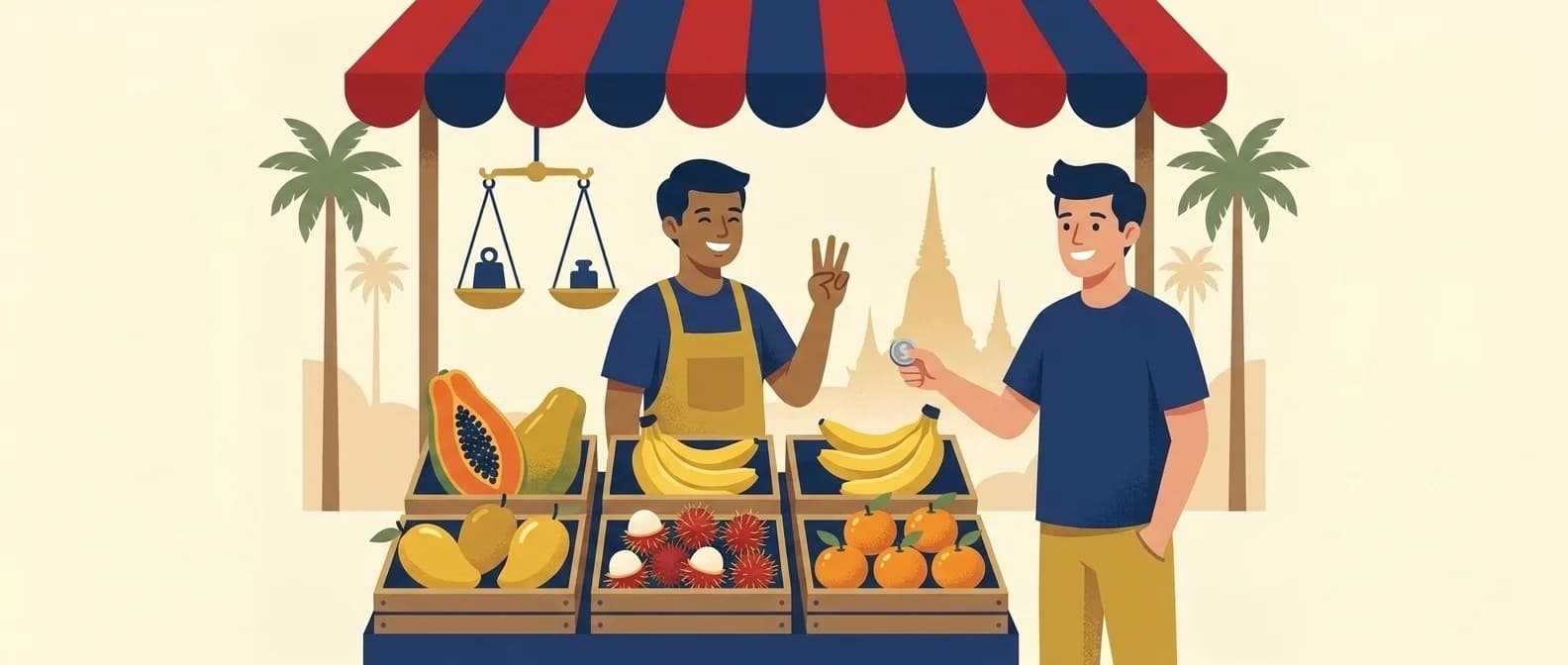
Thai numbers are one of the easiest parts of the language: learn eleven words (zero through ten) and two small rules, and you can count to a million. No "eleven/twelve" irregulars, no "seventy versus seventeen" confusion. The whole system is built like Lego.
There are exactly two surprises, and they both live in this sentence: 11 ends in -èt (not nɨ̀ng), and 20 starts with yîi- (not sɔ̌ɔng). Everything else is pure assembly.
Key takeaways
- Numbers 0-10 are the only vocabulary you must memorize; everything above is composed from them.
- 11 is sìp-èt: the final "one" becomes èt in every number ending in 1 (21, 31, 101…).
- 20 is yîi-sìp: "two-tens" uses yîi instead of the normal word for two. Only 20 does this.
- Thailand has its own digits (๐-๙); you'll meet them on price signs and official documents.
- Big numbers get a new word at each step: ร้อย (rɔ́ɔy, 100), พัน (phan, 1,000), หมื่น (mɨ̀ɨn, 10,000), แสน (sæ̌æn, 100,000), ล้าน (láan, 1,000,000).
Thai Numbers 0-10: the Only Ones You Memorize
Tap to hear each one. Tones matter here, since several numbers differ from everyday words only by tone:
(If the tone marks in the romanization are new to you, our Thai tones guide explains the system in five minutes of listening.)
Counting in Thai From 11 to 99: Two Rules, Then Assembly
Thai builds numbers exactly the way you'd hope: 30 is "three-ten", 35 is "three-ten five". The two exceptions:
Rule 1 — final 1 becomes เอ็ด (èt). Any number ending in 1 uses èt instead of nɨ̀ng: 11, 21, 31… 101.
Rule 2 — 20 is ยี่สิบ (yîi-sìp). The "two" in twenty is yîi, found nowhere else. 22 is yîi-sìp sɔ̌ɔng; 200 goes back to the normal word for two.
Why ยี่ (yîi) and not สอง (sɔ̌ɔng)? Both words trace back to Chinese — Teochew and Cantonese dialects, where yîi means "two" and sìp means "ten." The entire Thai counting system is built on this ancient Chinese base, carried over through centuries of trade. Thai absorbed the words wholesale for the tens (yîi-sìp = twenty) while keeping its own word สอง (sɔ̌ɔng) for standalone "two." The inconsistency isn't a bug; it's a trade route.
A few assembled examples:
| Number | Thai | Built as |
|---|---|---|
| 45 | สี่ สิบ ห้า (sìi sìp hâa) | four-ten five |
| 67 | หก สิบ เจ็ด (hòk sìp cèt) | six-ten seven |
| 99 | เก้า สิบ เก้า (kâaw sìp kâaw) | nine-ten nine |
Going Big: Hundreds, Thousands, and Up
Thai gives each magnitude its own word, including separate words for ten thousand and a hundred thousand, which English lacks:
They stack just like the tens: 2,500 is "two-thousand five-hundred" (สอง พัน ห้า ร้อย (sɔ̌ɔng phan hâa rɔ́ɔy)). A 35,000-baht motorbike costs "three ten-thousands, five thousands" (สาม หมื่น ห้า พัน (sǎam mɨ̀ɨn hâa phan)). Thais count in ten-thousands where English counts in thousands — the one mental shift big numbers require.
Here's the unadvertised payoff: order and bargain in Thai, and prices have a way of becoming friendlier. I've been quoted the local price many times for no other reason than doing the numbers in Thai — speak someone's language and you stop being quoted the tourist rate.
Thai Digits
๐ ๑ ๒ ๓ ๔ ๕ ๖ ๗ ๘ ๙Thailand uses Arabic numerals (1, 2, 3) almost everywhere, but the traditional Thai digits appear on official documents, temple signs, and occasionally dual-pricing signs. Worth recognizing:
| Thai digit | ๐ | ๑ | ๒ | ๓ | ๔ | ๕ | ๖ | ๗ | ๘ | ๙ |
|---|---|---|---|---|---|---|---|---|---|---|
| Value | 0 | 1 | 2 | 3 | 4 | 5 | 6 | 7 | 8 | 9 |
If a national park entrance lists one price in Thai digits and one in Arabic numerals, reading ๔๐ as 40 can tell you what locals pay.
A confession that should motivate you to learn these: after six years of Thai, I can hold a conversation — and I still stall at the Thai-digit-only price signs at temples, parks, and hiking trails (which is exactly where dual pricing lives). Ten symbols. Learn them in an afternoon and skip my years of squinting.
Using Thai Numbers in Real Life
The question you'll use numbers with most:
Add it after the thing you're asking about, sprinkle in your polite particle (khráp/khâ), and you're shopping in Thai. Prices come back at you fast; a good ear-training trick is to read any number you see (license plates, price tags) aloud in Thai, then check yourself by pasting the Thai into our free transliteration tool.
Get the Thai numbers practice pack
Join the list for printable number drills, audio practice, and early access to the full beginner lesson path.
FAQ
How do you count to 10 in Thai?
From one to ten: nɨ̀ng, sɔ̌ɔng, sǎam, sìi, hâa, hòk, cèt, pæ̀æt, kâaw, sìp. Zero is sǔun. These eleven words are the only number vocabulary you need to memorize — everything larger is built from them.
Why is 11 sìp-èt and not sìp-nɨ̀ng?
Thai uses a special word, èt, whenever 1 is the final digit of a larger number — 11, 21, 31 and so on. It is a fixed historical form, similar to how English says eleven rather than ten-one. Only the final position changes; 100 still begins with the normal word for one.
Does Thailand use Thai or Arabic numerals?
Mostly Arabic numerals (1, 2, 3) in daily life, signage, and phones. The traditional Thai digits ๐-๙ still appear on official documents, lottery tickets, temple inscriptions, and some price signs, so recognizing them is useful.
How do Thais say large numbers like 100,000?
Thai has dedicated words for each magnitude: rɔ́ɔy (hundred), phan (thousand), mɨ̀ɨn (ten thousand), sæ̌æn (hundred thousand), and láan (million). So 100,000 is one word, sæ̌æn, rather than a phrase like in English.
That's all of Thai numbers: eleven words, two rules, and a bonus set of digits. Hear them used in real dialogue (and practice answering "how much?") in our free first lesson.