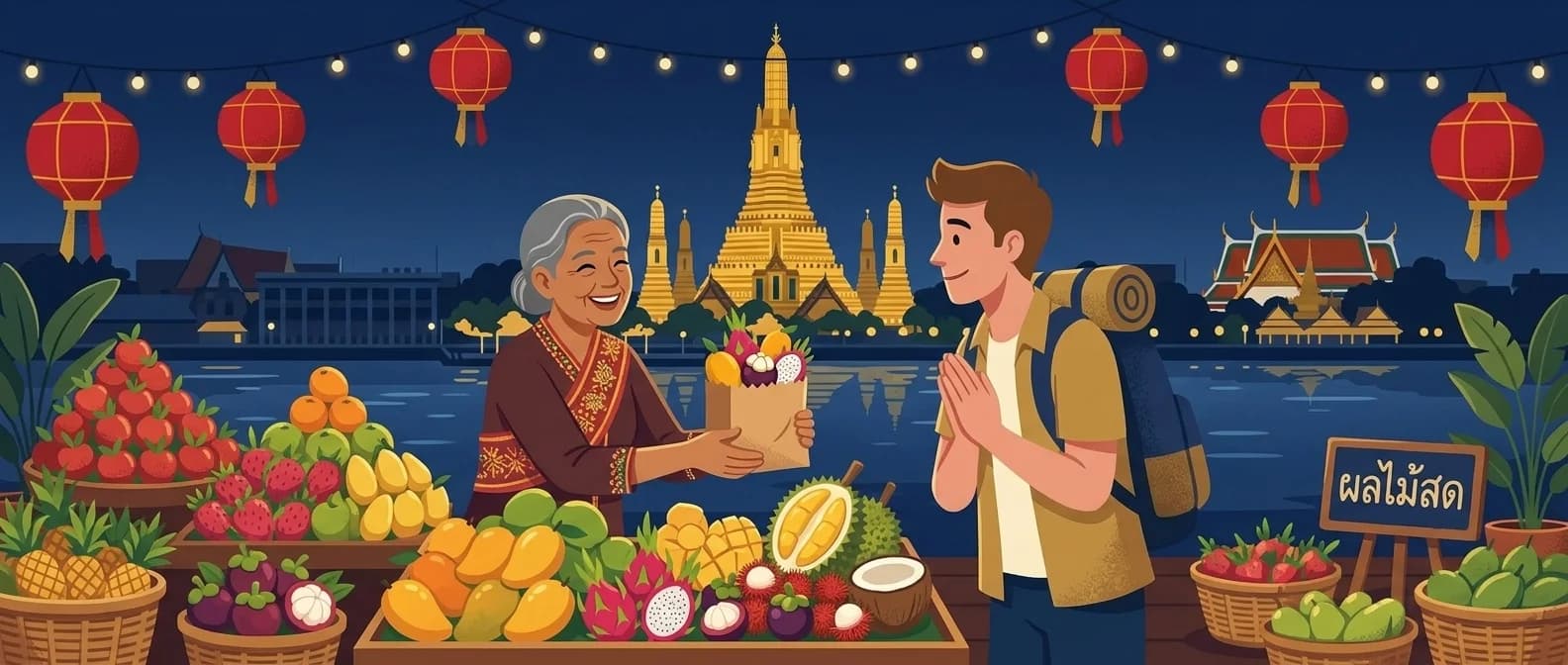
Thank you in Thai is ขอบคุณ (khɔ̀ɔp-khun) — men end it with ครับ (khráp) and say ขอบคุณ ครับ (khɔ̀ɔp-khun khráp); women end it with ค่ะ (khâ) and say ขอบคุณ ค่ะ (khɔ̀ɔp-khun khâ). Those two sentences cover roughly nine out of ten situations you'll meet in Thailand.
The other one out of ten is where it gets interesting, and where most guides stop short.
I'll admit how I started. On my first trips to Thailand, I had two polite phrases memorized and not enough sleep. I mixed up ขอบคุณ ครับ (khɔ̀ɔp-khun khráp, “thank you”) with สวัสดี ครับ (sa-wàt-dii khráp, “hello”), and for a couple of days I walked around Bangkok cheerfully saying thank you to strangers on the street as a greeting.
People looked at me like something was slightly wrong with me. Nobody corrected me; that's not very Thai. They just smiled carefully and moved on.
So this guide does two things. It gives you the phrase, the tones, and the audio in the first minute. Then it covers what the phrase books skip: the casual forms Thais actually use with each other, why you've seen it spelled kapunka, khob khun, and kop koon on three different menus, how to respond when someone thanks you, and when a wai belongs in the picture.
Key takeaways
- Thank you in Thai is ขอบคุณ (khɔ̀ɔp-khun): low tone on khɔ̀ɔp, mid tone on khun. Add khráp (men) or khâ (women) to make it polite.
- Most "20 ways to say thank you" lists are really one phrase with different endings: มาก (mâak, "a lot"), นะ (ná, a softener), and the polite particles.
- With close friends and kids, Thais say ขอบใจ (khɔ̀ɔp-cay) instead, and you'll hear the English loan แต๊งกิ้ว (tǽng kîw) constantly in Bangkok.
- Kapunka and khob khun kha are the same word in different ear-spellings; there's no single official way to write Thai in Latin letters.
- The standard reply is ไม่เป็นไร (mây-pen-ray), but a smile or a simple khráp/khâ is just as common.
The quick answer
Use ขอบคุณ ครับ (khɔ̀ɔp-khun khráp) or ขอบคุณ ค่ะ (khɔ̀ɔp-khun khâ).
Two tones do the work here. The first syllable khɔ̀ɔp carries a low tone (that's what the à-style mark means), and khun is a plain mid tone. Keep khɔ̀ɔp flat and low rather than letting it fall, and you'll sound right. If the tone marks are new to you, our guide to the five Thai tones explains the whole system in a few minutes, and you can paste any phrase from this page into our free Thai transliteration tool to see and hear its tones word by word.
The particle at the end is not optional politeness theater, by the way. A bare ขอบคุณ (khɔ̀ɔp-khun) to a stranger sounds clipped, the way a flat "thanks" can in English. Which particle you use depends on your gender, not the listener's: men say khráp, women say khâ. If that distinction is new, the khráp or khâ guide covers it properly.
How do you say thank you very much in Thai?
Here's an honest secret about this topic. Articles promising "15 ways to say thank you in Thai" are mostly selling you one phrase with interchangeable endings. The real system is small and regular, and you can learn it as a pattern instead of a list:
ขอบคุณ (khɔ̀ɔp-khun) + (intensifier) + (softener) + (polite particle)
To thank someone for doing something, use ขอบคุณ ที่ (khɔ̀ɔp-khun thîi) plus a verb: ขอบคุณที่มา (khɔ̀ɔp-khun-thîi-maa, “thank you for coming”). To thank someone for a specific thing, use ขอบคุณ สำหรับ (khɔ̀ɔp-khun sǎm-ràp) plus a noun: ขอบคุณ สำหรับ อาหาร อร่อย ๆ (khɔ̀ɔp-khun sǎm-ràp aa-hǎan à-rɔ̀ɔy à-rɔ̀ɔy, “thank you for such delicious food!”).
Mix freely. ขอบคุณ มากๆ (khɔ̀ɔp-khun mâak mâak) นะคะ (ná-khá) is a perfectly natural, very warm "thank you so much!" from a female speaker. You now know more combinations than most listicles contain.
What do Thais actually say to each other?
Textbook Thai and street Thai overlap less than you'd hope. Three things you'll hear constantly that beginner guides underplay:
ขอบใจ (khɔ̀ɔp-cay) is the casual thank you, literally closer to "thanks." Thais use it with close friends, younger people, and children. The direction matters: it flows downward or sideways, never up.
Saying ขอบใจ (khɔ̀ɔp-cay) to your boss, an elder, or a police officer would land somewhere between overly familiar and rude. When in doubt, ขอบคุณ (khɔ̀ɔp-khun) is never wrong.
แต๊งกิ้ว (tǽng kîw) is exactly what it sounds like: "thank you," borrowed from English and re-tuned with Thai tones. Young Thais use it with friends all the time, in speech and in chat. You don't need to adopt it, but you do need to recognize it, or you'll spend your first week wondering why everyone is saying "tang-kew."
A standalone khráp or khâ often is the thank you. When a 7-Eleven cashier hands you change and you both say khráp, a micro-transaction of politeness has been completed. No ขอบคุณ (khɔ̀ɔp-khun) required. Thais acknowledge small services with the particle alone far more often than with the full phrase.
Why is it spelled kapunka, khob khun, kop khun, khawp khun...?
If you've been googling, you've met the chaos: khob khun kha, kop khun krap, khawp khun, kapunkap, kapunka. They're all the same two or three Thai words. Thai has its own script, and there is no single agreed way to write Thai sounds in Latin letters. The government's own system (RTGS) drops tones entirely, so the internet improvises by ear, and everyone's ear is different.
| You've seen | What it is | In Thai |
|---|---|---|
| khob khun / kop khun / khawp khun | ขอบคุณ (khɔ̀ɔp-khun) | thank you |
| khop khun kha / kob kun ka | ขอบคุณค่ะ (khɔ̀ɔp-khun khâ) | thank you (female) |
| kop khun krap / kob kun krab | ขอบคุณครับ (khɔ̀ɔp-khun khráp) | thank you (male) |
| kapunkap | ขอบคุณครับ (khɔ̀ɔp-khun khráp), said fast | the same phrase at street speed |
| kapunka | ขอบคุณค่ะ (khɔ̀ɔp-khun khâ), said fast | likewise |
The kapun- spellings are the most honest of the bunch: they record what the phrase actually sounds like at conversational speed, when the careful khɔ̀ɔp compresses and the syllables blur. If you say "kapunkap" in a restaurant, you will be understood perfectly.
On this site every romanization is generated by one engine with tones marked, so a word is always spelled the same way on every page. When you find Thai text in the wild and want to know what it really says and how it sounds, paste it into the transliteration tool; that's what it's for.
How do you respond to thank you in Thai?
The classic reply is ไม่ เป็น ไร (mây-pen-ray): "it's nothing, no problem, never mind." It's also one of the most culturally loaded phrases in the language, an all-purpose verbal shrug that smooths over everything from spilled coffee to genuine favors.
But it's not the only reply, and often not the most natural one:
And very often the answer is just a smile. Thais frequently respond to thanks with a nod, a smile, or a single khráp/khâ rather than a phrase. Generosity has its own word here, น้ำใจ (nám-cay, literally “water of the heart”): the small, unprompted kindnesses that don't expect anything back, including a big thank-you.
A quick thank-you conversation
khɔ̌ɔ-thôot khráp sà-thǎa-nii sà-yǎam yùu thîi-nǎy khráp
Excuse me, where is Siam station?
trong-pay lǽæw líaw sáay khâ prà-maan hâa naa-thii khâ
Go straight and turn left. It's about five minutes.
khɔ̀ɔp-khun mâak khráp
Thank you very much!
yin-dii khâ
You're welcome.
Do you wai when you say thank you?
The wai, palms together, slight bow, is Thailand's politeness gesture, and foreigners reliably overuse it. The rule of thumb: a wai accompanies thanks upward, toward age, seniority, or status, and it is not used for routine service.
| Situation | Say | Wai? |
|---|---|---|
| Cashier hands you change | khráp / khâ, or khɔ̀ɔp-khun khráp/khâ | No, a smile or nod |
| Grab or taxi driver | khɔ̀ɔp-khun khráp/khâ | No |
| Waiter brings your food | khɔ̀ɔp-khun khráp/khâ | No; don't wai the waiter |
| A friend helps you move apartments | khɔ̀ɔp-cay ná / khɔ̀ɔp-khun mâak | No, friends don't wai each other |
| Your Thai teacher, at the end of a course | khɔ̀ɔp-khun khráp/khâ or khɔ̀ɔp-khun mâak khráp/khâ | Yes |
| Your partner's parents host you for dinner | khɔ̀ɔp-khun mâak khráp/khâ | Yes |
| Someone clearly senior does you a real favor | khɔ̀ɔp-khun mâak-mâak + their title | Yes |
If someone wais you first, return it (except children and service staff performing a corporate wai, which gets a smile and a nod). When unsure, err toward no wai plus a sincere khɔ̀ɔp-khun; that's never offensive. Over-waiing just marks you as a tourist, which, to be fair, mây-pen-ray.
Pick the right thank you
Thank you in Isan and Northern Thai
Two regional bonuses, because almost nobody covers them. In Isan (the northeast, where the local language is close to Lao), you'll hear ขอบใจ หลาย เด้อ (khɔ̀ɔp-cay lǎay də̂ə), roughly "thanks a lot, yeah." In the North around Chiang Mai, the soft Lanna particle เจ้า (câw) replaces khráp/khâ, so a thank you becomes ขอบคุณ เจ้า (khɔ̀ɔp-khun câw). Use either in the right region and watch faces light up; standard ขอบคุณ (khɔ̀ɔp-khun) works everywhere regardless.
FAQ
What does kapunka mean?
Kapunka is an ear-spelling of khɔ̀ɔp-khun khâ, 'thank you' said by a female speaker as it sounds at natural speaking speed. Kapunkap is the male version, khɔ̀ɔp-khun khráp.
Is it khop khun kha or khop khun krap?
It depends on who is speaking, not who is listening. Women say khɔ̀ɔp-khun khâ; men say khɔ̀ɔp-khun khráp. The base phrase khɔ̀ɔp-khun is the same for everyone.
How do you respond when a Thai person thanks you?
The standard reply is mây-pen-ray ('no problem'). A warm alternative is yin dii ('my pleasure'), and very often a smile with a simple khráp or khâ is the most natural response of all.
Is khop jai rude?
Khɔ̀ɔp-cay is not rude with the right people: close friends, children, people younger than you. It becomes disrespectful aimed at elders, bosses, or strangers. If unsure, use khɔ̀ɔp-khun.
Do Thai people say thank you less than Westerners?
For small routine services, often yes; a nod or a single khráp or khâ does the job, and constant explicit thanking can even feel oddly formal. For genuine favors, thanks are warm and often come with a wai.
Recap: ขอบคุณ ครับ (khɔ̀ɔp-khun khráp) if you're a man, ขอบคุณ ค่ะ (khɔ̀ɔp-khun khâ) if you're a woman. Add มาก (mâak) to mean it more, นะ (ná) to mean it warmly, switch to ขอบใจ (khɔ̀ɔp-cay) with friends, and answer thanks with ไม่ เป็น ไร (mây-pen-ray) or just a smile. Low tone on khɔ̀ɔp, and you're already ahead of the spelling-chaos crowd.
Just don't do what I did and greet strangers with it. Learn hello separately; the two phrases share a khráp but not a meaning.
Hear thank you in a real conversation
Try the first Speak lesson freeAudio on every line, tone-marked romanization, and exercises to check yourself.