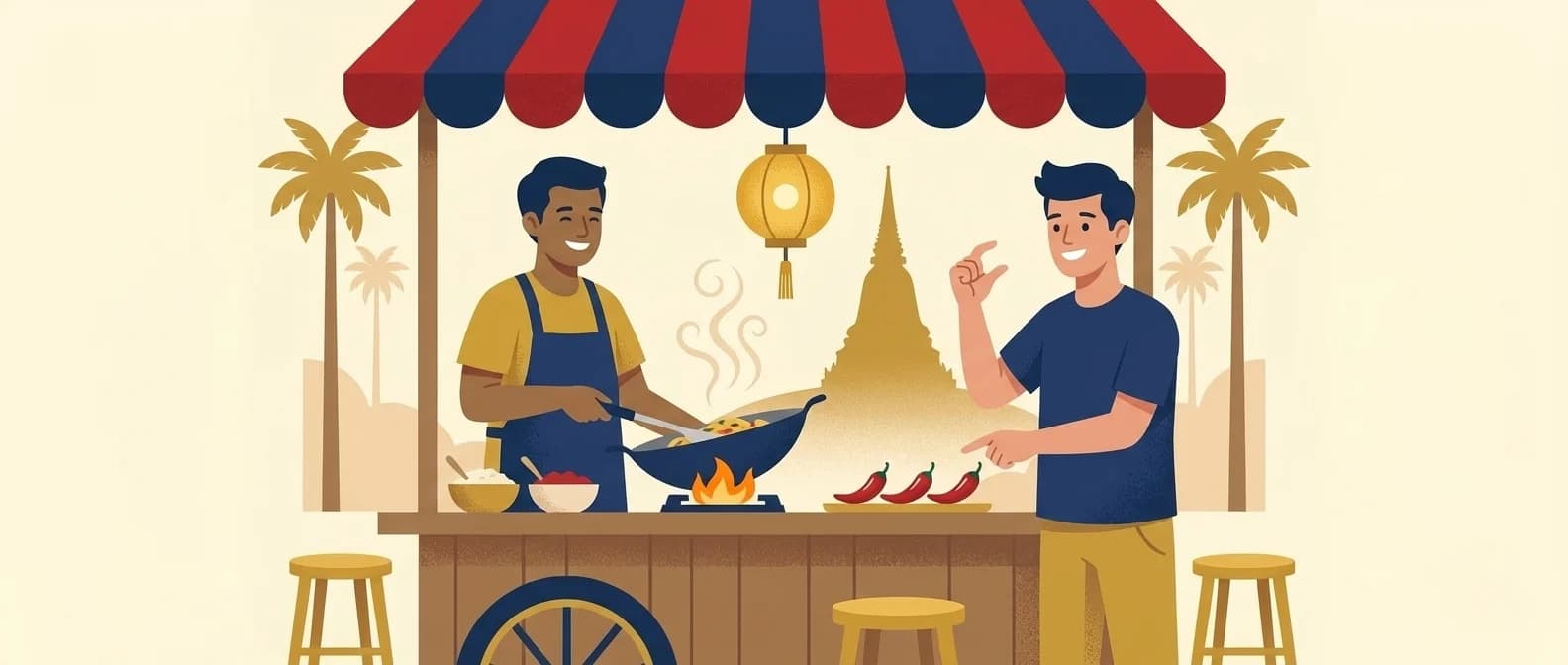
The basic Thai phrases worth learning first are the ones that do real work: thank you, how much, where's the bathroom, not spicy please. This list is those phrases, each with audio and tone-marked romanization, grouped by the situation you'll actually be standing in.
Two quick rules make every phrase below politer and more natural. First, add ครับ (khráp, male speakers) or ค่ะ (khâ, female speakers) to the end of almost anything. Second, don't worry about full sentences — Thai conversation runs happily on short phrases, and locals will meet you halfway.
Key takeaways
- Politeness lives in one syllable: end phrases with khráp (men) or khâ (women).
- The all-purpose phrases: khɔ̀ɔp-khun (thank you), khɔ̌ɔ-thôot (excuse me), mây-pen-ray (no problem).
- Negate almost anything with mây before the word: chɔ̂ɔp = like, mây chɔ̂ɔp = don't like.
- Question words come at the end in Thai almost all the time: "this how-much?", "bathroom where?"
- Tap any phrase below to hear it — tones are part of the word, not decoration.
The Essentials: Basic Thai Phrases You'll Use Every Day
If you learn nothing else, learn these (greetings have their own guide):
Notice the pattern in the last four: ไม่ (mây) in front of a word negates it. That one habit multiplies your vocabulary instantly: like, don't like; can, can't; want, don't want.
Question Words: Ask Anything With Six Syllables
Thai puts question words at the end of the sentence almost all the time: "this how-much?", "bathroom where?". Master these and you can improvise:
Note on ทำไม (tham-may, why): the one exception is "why not…?" — here ทำไม (tham-may) moves to the front. ทำไม คุณ ไม่ มา (tham-may khun mây maa, “Why don't you come?”). You would never say คุณ ไม่ มา ทำไม (khun mây maa tham-may) for that meaning. For plain "why?" questions, end-placement still works: ไป ทำไม (pay tham-may) — "Why are you going?"
And the single most-asked tourist question, ready-made:
Eating: the Phrases That Earn Smiles
If I'm honest about which phrases I actually used most in my first years, it wasn't the polite formulas — it was food. Learning the names of my favorite dishes and how to order them (ต้มข่า ไก่ (tôm-khàa kày) was high on the list) did more for my daily life in Thailand than any phrasebook chapter. Start with the five dishes you already love; motivation handles the rest.
Food is where basic Thai phrases pay off fastest, and where one word (เผ็ด (phèt), spicy) can save your evening:
Shopping and Getting Around
อันนี้ (an-níi) plus เท่าไหร่ (thâw-rày, “this one, how much?”) is a complete, polite market transaction. Add your polite particle and you're shopping like you live there. (Numbers for understanding the answer are in our Thai numbers guide.)
When You're Stuck
The honest phrases. These buy you goodwill and a slower repeat:
Introducing Yourself
Note that "I" differs by speaker: men say ผม (phǒm), women say ฉัน (chán), the same speaker-gender logic as khráp/khâ.
Check the tones of any phrase you pick up
Try the free transliteration toolPaste any Thai text — word-by-word romanization with tone marks. No signup.
FAQ
What are the most important basic Thai phrases?
Start with khɔ̀ɔp-khun (thank you), khɔ̌ɔ-thôot (sorry/excuse me), mây-pen-ray (no problem), thâw-rày (how much), and mây phèt (not spicy) — plus the polite particle khráp or khâ at the end of each. Those cover most daily interactions.
How do you say thank you in Thai?
Thank you is khɔ̀ɔp-khun. Men say khɔ̀ɔp-khun khráp and women say khɔ̀ɔp-khun khâ. Add mâak ('very much') for emphasis: khɔ̀ɔp-khun mâak.
Do I really need the tones for simple phrases?
For short phrases, context usually rescues you — vendors hear 'thâw-rày' with wrong tones all day and still answer. But learning phrases WITH their tones from the start costs nothing extra and saves unlearning later, which is why every phrase here marks them.
How many Thai phrases do I need to get around?
Around 30-40 well-chosen phrases cover eating, shopping, directions, and courtesy — the set on this page. Thai conversation tolerates short phrases well, so you can be functional fast and grow from there.
That's the working set of basic Thai phrases: courtesy, questions, food, shopping, and the rescue lines. Hear them in real conversation (and practice responding) in our free first lesson, or jump to how Thai tones work to understand the marks you've been reading.