The Thai alphabet has 44 consonant letters (two of them obsolete, so 42 in everyday use), 28 main vowel forms built from 15 or so symbols, and 4 tone marks. It's written left to right, has no capital letters, and — the part that surprises everyone — no spaces between words.
That sounds like a lot. It isn't, once you see the system behind it: Thai script is one of the most regular writing systems you can learn. Unlike English spelling, Thai letters tell you exactly how a word sounds, including its tone. This guide shows you how the machine works, piece by piece, with audio so you can connect letters to sounds from the start.
Key takeaways
- The Thai alphabet has 44 consonants in 3 "classes" (mid, high, low); the class helps determine a syllable's tone.
- Vowels are written around the consonant: after, before, above, or below it.
- 4 tone marks plus the consonant classes produce Thai's 5 tones by rule, not by memorization per word.
- Thai is an abugida, not a true alphabet: consonants carry an inherent vowel sound.
- You don't need all 44 letters to start reading. About 25 cover the vast majority of real words.
How the Thai Script Works
Four things make Thai look intimidating, and none of them are actually hard:
- No spaces between words. Thai runs words together; spaces mark the ends of phrases or sentences instead. Readers recognize word boundaries the way you recognize them in speech. (Our transliteration tool does this segmentation automatically; paste any Thai sentence and it splits the words for you.)
- No capital letters, no plural forms, no verb endings. The script is simpler than English in every one of these ways.
- Vowels orbit the consonant. A vowel symbol can sit after, before, above, or below its consonant. In ดี (dii) the vowel sits above; in ไก่ (kày) it comes before the consonant it follows in speech.
- Letters encode tone. Consonant class + vowel length + type of syllable + tone mark = the tone, by rule. Once you know the rules, you can pronounce words you've never seen, correctly.
The 44 Thai Consonants and Their Names
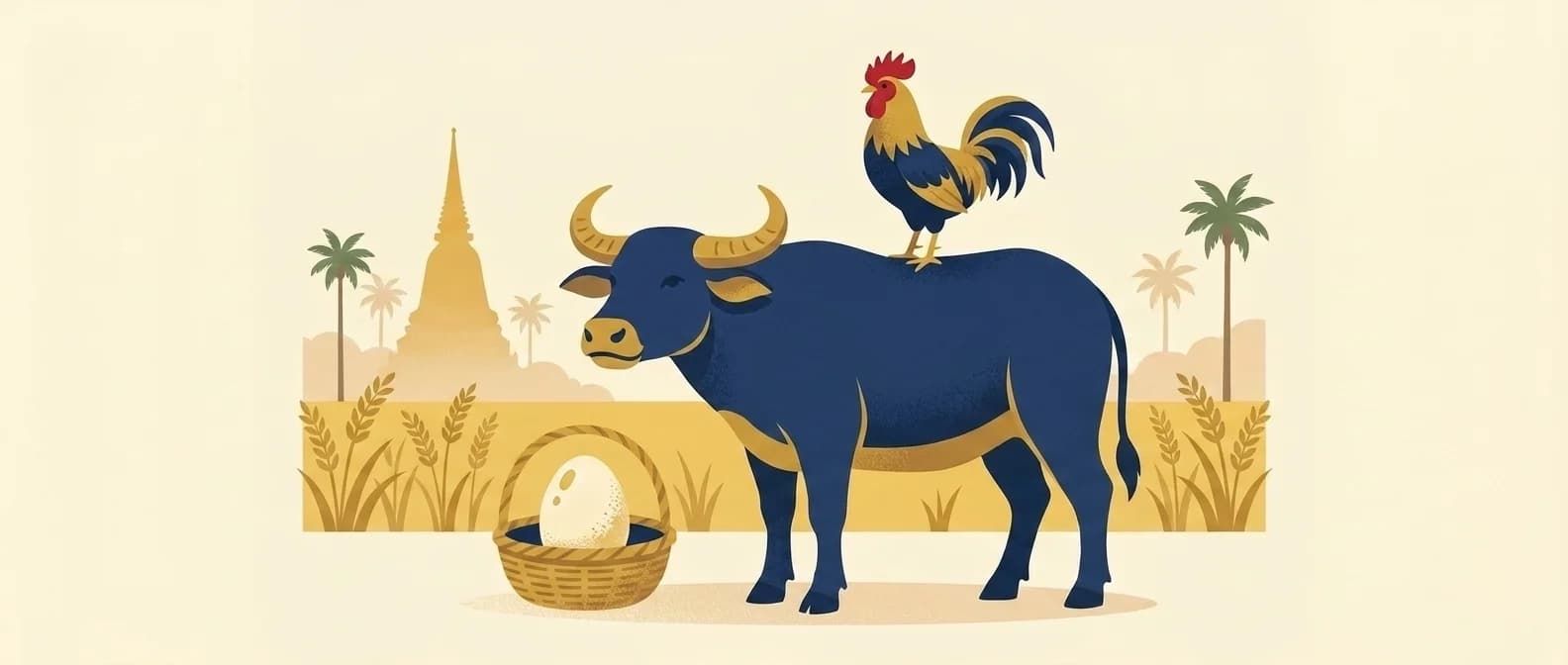
Every Thai consonant has a name: the letter plus a keyword that starts with it, like saying "A as in apple". The first three letters of the alphabet are the famous chicken, egg, and buffalo:
| Letter | Name word | Meaning |
|---|---|---|
| ก | ไก่ (kày) | chicken |
| ข | ไข่ (khày) | egg |
| ค | ควาย (khwaay) | water buffalo |
Thai children learn all 44 this way, and the name words matter for a practical reason: several letters share the same sound (there are, for example, multiple letters pronounced th and s), so Thais disambiguate by name — ส เสือ (sà sɨ̌a, tiger) versus ซ โซ่ (sá sôo, chain).
The good news for learners: those 44 letters map to exactly 21 consonant sounds, and two letters (ฃ and ฅ) are obsolete. You'll meet them only in alphabet charts.
The Complete Thai Alphabet: All 44 Letters
Here is the full alphabet in dictionary order, each letter with its name word, meaning, and consonant class (the class system is explained in the next section). The romanization of each name word shows you the letter's sound at the start of a real word.
Want this on paper? Grab our free printable Thai alphabet chart — a two-page PDF with all 44 letters color-coded by class, vowels, and tone marks. No email needed.
| # | Letter | Name word | Meaning | Class |
|---|---|---|---|---|
| 1 | ก | ไก่ (kày) | chicken | mid |
| 2 | ข | ไข่ (khày) | egg | high |
| 3 | ฃ | ขวด (khwòt) | bottle (obsolete) | high |
| 4 | ค | ควาย (khwaay) | water buffalo | low |
| 5 | ฅ | คน (khon) | person (obsolete) | low |
| 6 | ฆ | ระฆัง (rá-khang) | bell | low |
| 7 | ง | งู (nguu) | snake | low |
| 8 | จ | จาน (caan) | plate | mid |
| 9 | ฉ | ฉิ่ง (chìng) | finger cymbals | high |
| 10 | ช | ช้าง (cháang) | elephant | low |
| 11 | ซ | โซ่ (sôo) | chain | low |
| 12 | ฌ | เฌอ (chəə) | tree | low |
| 13 | ญ | หญิง (yǐng) | woman | low |
| 14 | ฎ | ชฎา (chá-daa) | headdress | mid |
| 15 | ฏ | ปฏัก (pà-tàk) | goad | mid |
| 16 | ฐ | ฐาน (thǎan) | pedestal | high |
| 17 | ฑ | มณโฑ (mon-thoo) | Montho (Ramakien character) | low |
| 18 | ฒ | ผู้เฒ่า (phûu-thâw) | elder | low |
| 19 | ณ | เณร (neen) | novice monk | low |
| 20 | ด | เด็ก (dèk) | child | mid |
| 21 | ต | เต่า (tàw) | turtle | mid |
| 22 | ถ | ถุง (thǔng) | bag | high |
| 23 | ท | ทหาร (thá-hǎan) | soldier | low |
| 24 | ธ | ธง (thong) | flag | low |
| 25 | น | หนู (nǔu) | mouse | low |
| 26 | บ | ใบไม้ (bay-máy) | leaf | mid |
| 27 | ป | ปลา (plaa) | fish | mid |
| 28 | ผ | ผึ้ง (phɨ̂ng) | bee | high |
| 29 | ฝ | ฝา (fǎa) | lid | high |
| 30 | พ | พาน (phaan) | pedestal tray | low |
| 31 | ฟ | ฟัน (fan) | tooth | low |
| 32 | ภ | สำเภา (sǎm-phaw) | junk (sailing ship) | low |
| 33 | ม | ม้า (máa) | horse | low |
| 34 | ย | ยักษ์ (yák) | giant | low |
| 35 | ร | เรือ (rɨa) | boat | low |
| 36 | ล | ลิง (ling) | monkey | low |
| 37 | ว | แหวน (wæ̌æn) | ring | low |
| 38 | ศ | ศาลา (sǎa-laa) | pavilion | high |
| 39 | ษ | ฤๅษี (rɨɨ-sǐi) | hermit | high |
| 40 | ส | เสือ (sɨ̌a) | tiger | high |
| 41 | ห | หีบ (hìip) | chest (box) | high |
| 42 | ฬ | จุฬา (cù-laa) | star kite | low |
| 43 | อ | อ่าง (àang) | basin | mid |
| 44 | ฮ | นกฮูก (nók-hûuk) | owl | low |
Don't try to memorize this table top to bottom — it's a reference, and the learning path at the end of this guide gives a saner order. Scan the Class column and you'll see runs of the same class — low-class letters form a long consecutive stretch from ม through ว, and the high-class letters ศ ษ ส ห appear together near the end. That grouping is what makes the classes learnable in chunks rather than as 44 individual facts to memorize.
Thai Consonant Classes: the Secret to Tones
This section is the short version; the full class system, with the memorization shortcut, lives in Thai consonants and the 3 classes.
The consonants of the Thai alphabet divide into three classes: mid, high, and low. The class doesn't change how the consonant sounds; it's one of the inputs that determines the tone of the syllable.
Hear the class system in action. These two words share the same sound kh, the same long vowel ii, and the same tone mark ่ — yet they have different tones, purely because of the consonant class:
Notice that ขี่ (khìi, to ride) and คี่ (khîi, odd number) use the exact same tone mark, yet land on different tones — because ข (khà) is high-class and ค (khá) is low-class.
You don't need to memorize tone tables on day one. Just absorb the idea: class + vowel length + tone mark + syllable type = tone, by rule. When you're ready, our Thai tones guide covers how the five tones sound, and the consonant classes are what connect the script to those sounds.
Thai Vowels: Short, Long, and Written Everywhere
(For the full system with audible length pairs, see Thai vowels explained.)
Thai vowels come in short/long pairs, and the length changes meaning, which is why our romanization doubles long vowels (aa, ii). Compare:
Vowel symbols attach to their consonant in four positions. In this table, อ (à) is just a vowel holder, so each mark renders the way it would on a real syllable:
| Position | Example | Where the vowel sits |
|---|---|---|
| After | อา (aa) as in มา (maa) | in อา (aa), the vowel follows อ (à) |
| Before | ไอ (ay) as in ไก่ (kày) | in ไอ (ay), the vowel is written before อ (à) but pronounced after it |
| Above | อี (ii) as in ดี (dii) | in อี (ii), the vowel sits on top of อ (à) |
| Below | อู (uu) as in งู (nguu) | in อู (uu), the vowel hangs under อ (à) |
This is the single biggest reading adjustment for English speakers: you learn to see a consonant-plus-marks cluster as one syllable, rather than scanning strictly left to right. It becomes automatic faster than you'd expect.
The 4 Thai Tone Marks
Thai has exactly four tone marks, written above the consonant:
| Mark | Name | |
|---|---|---|
| อ่ | ไม้เอก (máy-èek) | máay-èek — "first mark" |
| อ้ | ไม้โท (máy-thoo) | máay-thoo — "second mark" |
| อ๊ | ไม้ตรี (máyt-rii) | máay-trii — "third mark" |
| อ๋ | ไม้จัตวา (máy-càt-waa) | máay-càt-ta-waa — "fourth mark" |
Here's the catch that trips up self-learners: the mark alone doesn't tell you the tone. The mark combines with the consonant's class, and the same mark can produce different tones on different classes. That's why learning classes first (even loosely) pays off.
See it work: มา (maa), ม้า (máa), and หมา (mǎa) are all "maa" (to come, horse, and dog), distinguished purely by what's written around the ม.
Where to Start: a Sane Path to Learn the Thai Alphabet
If you want to learn the letters with a pen in hand, the handwriting guide covers stroke order and the shape families; writing letters is the fastest way to learn to tell lookalikes apart.
Don't start at ก and grind through 44 letters in order. A path that works:
- Learn the 9 mid-class consonants first (ก จ ด ต บ ป อ ฎ ฏ): fewest tone complications to start with. Within each class some letters are very common and others are rare — focus on the high-frequency ones before worrying about the full list.
- Add the long vowels (อา, อี, อู, เอ, แอ). Now you can read real syllables.
- Add high- and low-class consonants in frequency order, plus the short vowels.
- Tone marks last. By then the class system makes them logical instead of arbitrary.
Throughout, read words you already know how to say; your brain confirms the letters against sounds it trusts. Paste any word into the transliteration tool to check yourself: it shows the romanization with the exact tone for every word.
Get the Thai alphabet starter path
Join the list for reading practice, alphabet resources, and early access to the full Read track.
FAQ
How many letters are in the Thai alphabet?
Thai has 44 consonant letters, of which 42 are in modern use, plus 28 main vowel forms written from roughly 15 base symbols, 4 tone marks, and its own set of digits. Counting consonants alone, the answer is 44.
Is Thai an alphabet or an abugida?
Technically an abugida: each consonant carries an inherent vowel sound, and other vowels are written as marks around the consonant. In practice everyone calls it the Thai alphabet.
How long does it take to learn the Thai alphabet?
With 15-20 minutes a day, most learners can read slowly within 4-8 weeks. Reading at a comfortable speed takes a few months of practice. It is a very front-loaded skill: the rules are regular, so progress compounds.
Should I learn to read Thai or speak Thai first?
You can do either, but learning the script early pays off: Thai spelling tells you the exact pronunciation including tone, so reading skills make your speaking more accurate, not less. Many learners run both in parallel.
Why does Thai have no spaces between words?
Thai marks pause boundaries rather than word boundaries — spaces separate phrases and sentences. Readers segment words automatically by recognizing them, exactly as listeners do in spoken language.
The Thai alphabet rewards system-learners: 44 letters, 3 classes, 4 marks, and a set of rules that never lies to you about pronunciation. When you're ready to put it into practice, the Read track builds these skills lesson by lesson, starting from the first letters, with audio on every word.